
Compliance in commissioning: compliant with what, signed by whom?
The same test can satisfy a client specification, support a statutory inspection and become part of a certification dossier. Those are different obligations, with different authorities. Here is how to tell them apart in data centers, pharmaceutical facilities, HV substations and transmission lines across the United States, Europe and Latin America.
Every commissioning pack eventually reaches the same moment: somebody has to sign a box marked Accepted, Approved or Compliant.
Compliant with what?
Ask three engineers on the same project and you might get three answers: the electrical code, the owner's specification and the certification body's test criteria. The answers can all be relevant. They are not interchangeable.
This distinction matters because the person accepting a functional test may not be the person authorised to energise the equipment. A successful integrated systems test may not satisfy the local electrical inspector. And a signed vendor FAT can be valuable pharmaceutical qualification evidence without automatically replacing IQ or OQ.
We reviewed the published requirements and guidance behind four sectors in three regions. What emerges is not one universal commissioning rulebook. It is a series of overlapping obligations, and an evidence trail that has to survive all of them.
Scope note (19 October 2026): This article distinguishes published standards from legally adopted requirements. References to an edition indicate the published document, not necessarily the edition applicable to a specific project. Requirements depend on jurisdiction, installation type, permit date, connection agreement and contract. This is an engineering overview, not a legal determination for any particular site.
Compliant with what? Four different questions
Before asking whether a system complies, identify which question is being answered.
- Does it meet the law? Statutes, regulations and locally adopted codes govern electrical safety, building safety, environmental conditions and, in some cases, permission to energise or occupy. They assign authority to regulators, inspectors, registered installers or system operators. The relevant person and document depend on the installation.
- Does it meet the contract? Owners' Project Requirements, specifications, approved drawings, test procedures and acceptance criteria determine what the contractor has promised. ASHRAE Guideline 0-2019 and ANSI/ASHRAE/IES Standard 202-2024 provide widely used commissioning-process frameworks; they are not, by themselves, a universal legal permission to operate.
- Does it meet a certification scheme? Uptime Institute Tier, ANSI/TIA-942, LEED and other schemes apply their own rules. Participation is generally voluntary unless required by the owner, a contract, an insurer or another controlling instrument. EN 50600 is a family of technical standards, not an automatic certificate for every European data center.
- Can it be put into operation? Pharmaceutical manufacturing and interconnected electrical infrastructure have additional release, qualification, notification and operating requirements. The engineering test report may be essential evidence without being the final approval itself.
A well-designed commissioning plan maps each test to its requirement, applicable edition, acceptance criterion, witness, evidence and approval route. Otherwise, it is possible to pass every planned test and still be unable to hand over the facility.
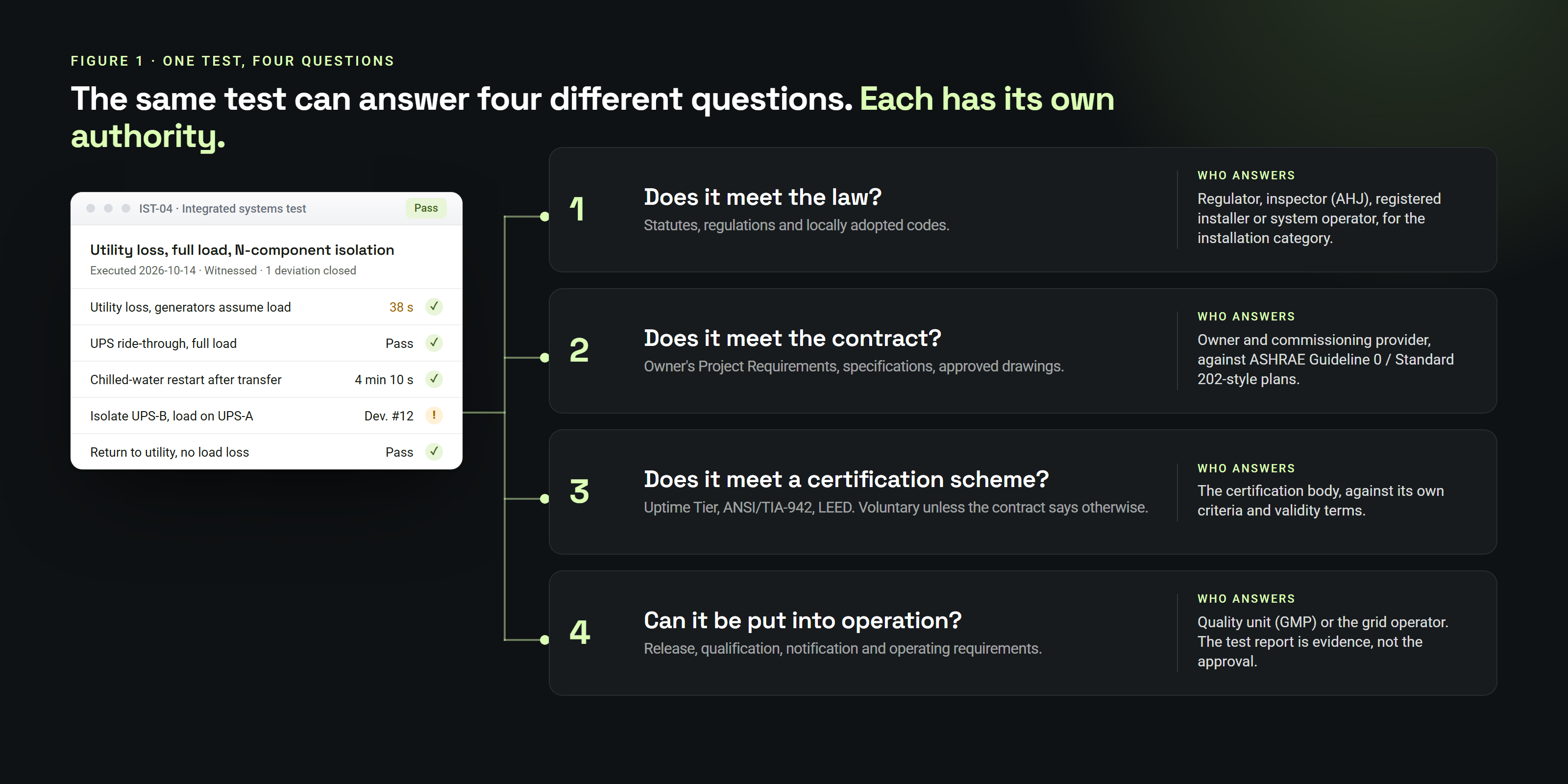 One test, four questions. Each has its own authority and its own document.
Three regions, different approval paths
United States: adopted codes first, commissioning evidence alongside them
In the US, model codes become enforceable through state or local adoption, often with amendments. A national standards body's latest publication is not necessarily the edition in your permit documents.
The 2026 National Electrical Code (NFPA 70) is the current published edition, but the enforcing jurisdiction may use an older one. The 2024 International Energy Conservation Code, where adopted with its commercial commissioning provisions, establishes testing and documentation obligations for certain building systems. The 2025 California Energy Code applies on its own adoption timetable and has detailed acceptance-testing forms and technician requirements for applicable lighting and mechanical systems. Not every California acceptance form requires the same certification or signature; the California Energy Commission distinguishes the form categories.
The building official, electrical authority having jurisdiction (AHJ), utility and owner may each have a separate acceptance role. A commissioning report supports those decisions; it does not automatically replace them.
European Union: common frameworks, national verification and sign-off
There is no single EU-wide certificate that authorises every electrical installation to energise. EU directives, European standards and national legislation interact, while the relevant inspection and connection procedures remain installation-specific.
IEC 60364-6:2016 is an important reference for low-voltage initial verification; national implementations and adopted editions must still be checked. In Spain, REBT / RD 842/2002 distinguishes installer verification from independent Organismo de Control inspection for specified categories of installation, not every low-voltage job. Germany has its own occupational electrical-safety inspection duties under DGUV Vorschrift 3. In Ireland, registered electrical contractors issue completion certificates for works covered by the national certification scheme; CRU explains the REC framework.
The recast Energy Performance of Buildings Directive (EU) 2024/1275 also addresses assessment and documentation of technical building-system performance. Its national implementation and the applicable building-system provisions matter. It is not a substitute for electrical initial verification.
Latin America: check the actual declaration, inspection and connection regime
"Latin America" is not one compliance jurisdiction. Even countries with similar engineering practices allocate legal responsibility differently.
In Mexico, NOM-001-SEDE-2012 remains listed as in force. Verification reports (dictámenes) are required for defined categories of installation; it would be wrong to say that every connection requires the same independent inspection.
In Colombia, the electrical installation regulation, RETIE, is based on Resolution 40117 of 2024 and subsequent changes, including Resolution 40284 of 23 June 2026. The Ministry of Mines and Energy maintains the current regulatory history. The applicable conformity route, installer declaration, inspection and, where required, full certification, depends on the work.
In Chile, relevant low-voltage installations follow the SEC declaration process, including TE1 where applicable. That process is different from the transmission-system operator's procedures for energising a grid-connected installation.
In Brazil, the existing NR-10 requires, among other duties, an electrical-installations dossier (Prontuário de Instalações Elétricas) for establishments above the specified 75 kW installed-load threshold. The Ministry of Labour confirms that the revised NR-10 published in 2026 does not enter into force until 1 June 2027.
The practical rule across these markets is simple: identify the regulator or operator, the precise installation category and the document it requires. A technically complete commissioning report is not necessarily that document.
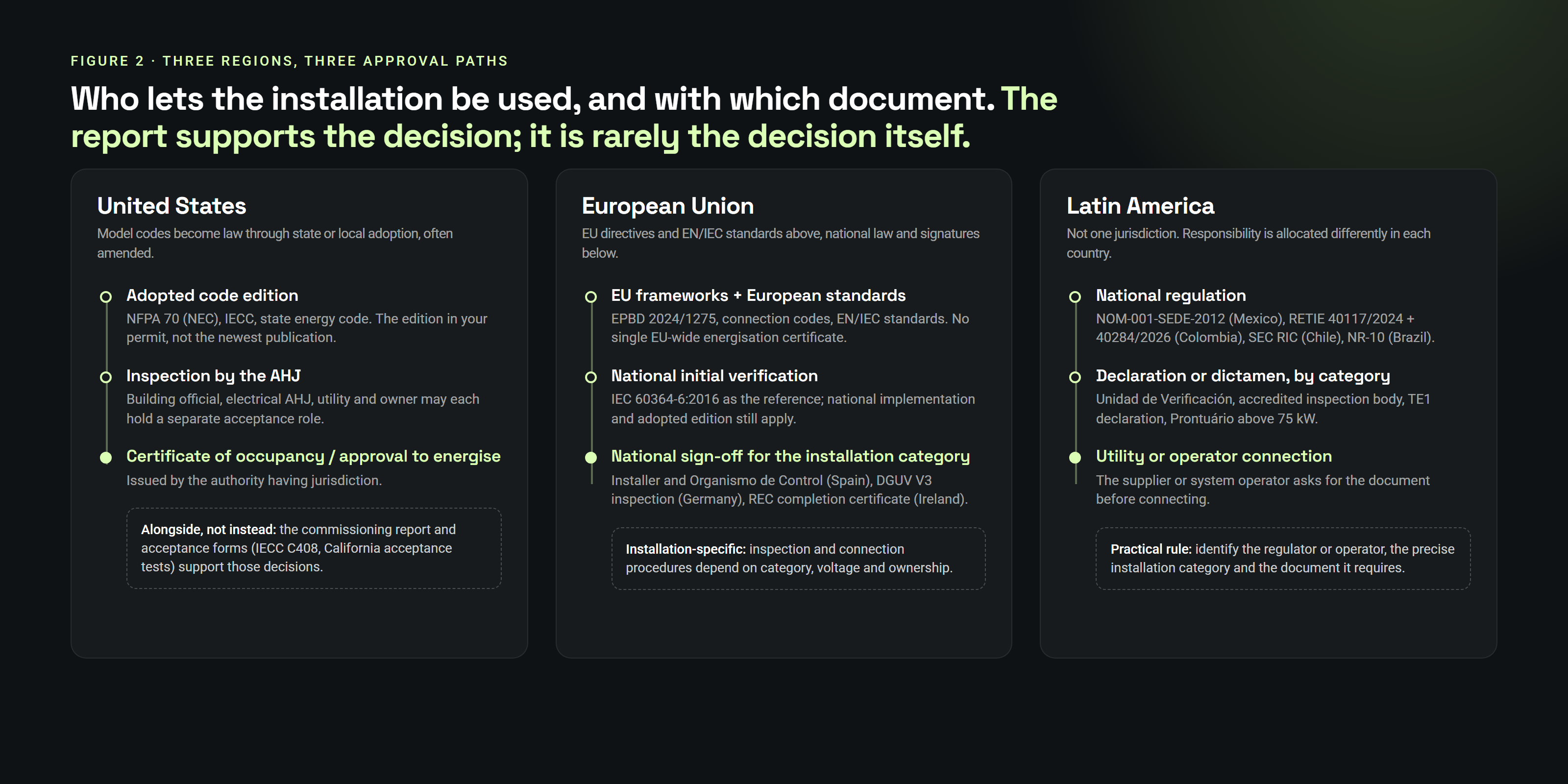 Three regions, three approval paths. The report supports the decision; it is rarely the decision itself.
Data centers: the contract defines the demonstration; codes still govern safety
The familiar data-center Levels 1–5 describe an industry commissioning sequence, from factory inspection to increasingly integrated site tests. Their precise scope and numbering vary by owner and commissioning provider. They should be defined in the project contract and commissioning plan, not presented as a universally mandated standard.
The certification route is separate. Uptime Institute's Tier Certification of Constructed Facility assesses the constructed infrastructure and performance demonstrations against its criteria. Uptime explicitly states that the constructed-facility award remains valid until changes are made to the certified infrastructure, including capacity components or distribution paths. ANSI/TIA-942-C, published in May 2024, is a distinct data-center infrastructure standard, with its own approach to ratings and assessment. LEED v5 also includes fundamental commissioning requirements as part of its building-certification framework. In Europe, EN 50600-3-1:2026 addresses data-center management and operation and supersedes the 2016 edition; it may influence the handover requirements when referenced by the contract, but does not automatically govern every facility. NEN lists the current EN 50600-3-1 publication.
None of these awards overrides the electrical, fire or building authority. Passing an owner's Level 5 integrated systems test does not automatically approve a generator installation, switchgear modification or fire-safety interface.
For electrical acceptance testing, ANSI/NETA ATS-2025 provides a recognised specification for assessing the suitability of electrical power equipment and systems for initial energisation. Its use is normally established by the project specification or another applicable requirement. Generator acceptance and emergency-power tests depend on the adopted edition and scope of standards such as NFPA 110, the authority having jurisdiction and the approved test plan; a two-hour full-load test is not a universal requirement for every generator.
Maintenance is another separate obligation. NFPA 70B was converted from a recommended practice to a standard in its 2023 edition, and the current published edition is NFPA 70B-2026. It provides requirements for an electrical maintenance program, but whether a particular provision is legally enforceable depends on adoption or incorporation into another binding obligation. An as-commissioned test record can provide the starting condition for future maintenance, one reason not to discard it at handover. NFPA's edition information is the reliable reference for this distinction.
The new commissioning consequence: energy data
In the EU, Directive (EU) 2023/1791, Article 12, establishes disclosure obligations for data centers meeting the 500 kW installed-IT-power threshold, subject to stated exceptions. Delegated Regulation (EU) 2024/1364 sets out information and reporting arrangements, including the recurring 15 May reporting cycle.
Germany goes further. Under § 11 of the Energieeffizienzgesetz, covered data centers entering operation on or after 1 July 2026 have a PUE target of 1.2 or lower, to be met within two years, alongside heat-reuse provisions and statutory exceptions. The law's definitions and thresholds must be checked before applying that figure to an individual site.
Neither law is a generic Level 5 test specification. Both create a practical requirement for the project: establish defensible measurements of IT energy, facility energy, and relevant water or heat indicators. Commissioning the meters, their data points and the calculation method is prudent engineering because the operator will need reliable operating data later. This recommendation follows from the reporting obligation; it should not be confused with a statutory requirement to witness every meter at handover.
Pharmaceutical facilities: when engineering tests become GMP evidence
Pharmaceutical work exposes the most important difference between an engineering test and a formally accepted qualification record.
The controlling framework in the EU is EudraLex Volume 4, Annex 15: Qualification and Validation, in operation since 1 October 2015. Its framework covers user requirements, design qualification and risk-based qualification and validation. In the US, the legal requirements include 21 CFR Part 211, including equipment design, maintenance, automated systems, records and quality-unit controls. The FDA's 2011 Process Validation Guidance is guidance, not a substitute for those regulations.
Engineering teams call their work commissioning, FAT and SAT. GMP teams call parts of the verification DQ, IQ, OQ and PQ. The overlap is real, but it has to be controlled.
Annex 15, clause 3.6, allows testing performed at FAT or other stages to avoid repetition at IQ/OQ where justified, for example, if transport and installation cannot affect the function tested. It does not declare that any vendor FAT automatically counts as qualification.
A particularly useful October 2026 development is PIC/S PI 006-4, Recommendations on Qualification and Validation, effective 1 October 2026. Section 4.1.7 confirms that properly justified FAT and SAT work can reduce the required IQ/OQ scope. Sections 4.2.3 and 4.2.4 discuss formally approved FAT and SAT protocols and reports. The recommendations also call for independent confirmation of data integrity by personnel who did not execute the qualification/validation work, with the process defined in the validation master plan (section 3.4.3(m)). They recognise alternative science- and risk-based verification approaches, including ASTM E2500-25.
An important legal distinction: PI 006-4 is a PIC/S recommendations document. It informs inspection practice, but PIC/S membership does not make every sentence of it directly binding law in every member jurisdiction. The local GMP rules, product, manufacturing authorisation and pharmaceutical quality system still govern.
What a reusable FAT/SAT record needs
If the goal is to rely on an engineering test for qualification, design the record accordingly:
- Traceability: identify the user requirement, system, function, approved acceptance criterion and risk the test addresses.
- Control: use the approval, revision and execution process specified by the site's pharmaceutical quality system; preserve the approved protocol and report.
- Scientific justification: explain why the FAT or SAT result remains valid after shipment, installation or modification; repeat what can reasonably have changed.
- Raw evidence: retain actual readings, instrument information, relevant audit trails and contemporaneous records rather than only a final "Pass" cell.
- Deviations: record unexpected and failed results, assess their impact and document disposition or corrective actions. Retesting must not erase the original outcome.
- Ownership and review: make the record available to the manufacturer and the responsible quality personnel, with review appropriate to the applicable GMP framework.
Those are not six identical statutory checklist items in every country. They are a defensible way to produce records that can support an applicable qualification decision.
There is a concrete reason to take this seriously. In an FDA warning letter dated 10 April 2026 to Fareva Amboise, investigators described particle-monitoring systems whose operators could change dates and alarm limits without adequate restriction. The letter also documented missing original out-of-limit results and electronic records deleted during vendor calibration without backup. It cites 21 CFR 211.68(b), among other provisions. These are not just software problems; they undermine the reliability of the evidence used to establish and maintain control.
Regulatory texts are still evolving. Proposed EU revisions to Annex 11, Chapter 4 and a new Annex 22 on AI were consulted on in 2025; the Commission's consultation must not be mistaken for effective final rules. For Latin American pharmaceutical projects, the binding national texts matter even where they follow broadly similar international principles. Brazil identifies ANVISA IN 138/2022 as its supplementary GMP provision for qualification and validation; the ANVISA regulations index explicitly maps it to Annex 15. Mexico applies NOM-059-SSA1-2015, with a 2025 amendment published in the Diario Oficial that changes specified points rather than replacing the entire GMP framework. In Argentina, ANMAT Disposición 4159/2023 approved its national GMP guide. These are jurisdiction-specific obligations: PIC/S participation is not a shortcut around local law.
High-voltage substations: the power to energise is not the same as the power to approve a test
Substation compliance has two distinct layers: technical acceptance and authorisation to connect or energise.
In Europe, the directly applicable network connection codes, for example, Commission Regulation (EU) 2016/631 for relevant generating facilities and Regulation (EU) 2016/1388 for applicable demand and distribution facilities, establish compliance and notification processes for defined connection categories. Energisation, interim and final operational notifications are not a universal three-step process for every substation. Their applicability depends on the type of connected facility and the regulation's classifications. The relevant system operator and connection agreement also matter.
Technical tests draw on other documents. IEC 61936-1:2021 addresses power installations above 1 kV AC. IEC 62271-203:2022 applies to gas-insulated metal-enclosed switchgear above 52 kV. Protection and automation work may also refer to the IEC 61850 series, while earthing design and verification have their own standards and national rules. Each standard covers a different part of the work; none automatically replaces the approved commissioning procedure.
In Spain, RD 337/2014 establishes detailed high-voltage installation verification and inspection rules, including independent inspection for specified categories. It is incorrect to assume that every substation, regardless of ownership and classification, requires precisely the same external inspection procedure.
In the US, the boundary is equally important. NERC PRC-005-6 is primarily a protection system maintenance standard for applicable registered entities, not a general permission-to-energise checklist. PRC-027-1 addresses coordination of protection systems. These requirements can make original settings, trip-path records and baseline test results valuable long after commissioning, but initial energisation is governed by the relevant operator, utility and project-specific procedures. The technical baseline can include ANSI/NETA ATS-2025 and the current IEEE 81-2025 guide for measuring earth resistivity, ground impedance and earth surface potentials where applicable.
Latin American grid operators likewise maintain connection and test-approval procedures that are different from ordinary electrical installation declarations. In Chile, a new grid-connected facility may need an approved test programme and switching arrangements through the Coordinador Eléctrico Nacional. In Brazil, the ONS network procedures and integration process govern facilities entering the national system. For generating plants, ANEEL's current test/commercial-operation procedure refers to REN 1.029/2022; that is a distinct issue from acceptance of a new transmission installation. In Mexico, Colombia and Peru the applicable operator's connection documentation must be reviewed project by project.
For the commissioning engineer, the practical question is not just "Did the relay pass?" It is "Who reviewed the settings, who has authority over the switching sequence, and which records must be accepted before the breaker can be closed?"
Transmission lines: the as-built is part of the continuing compliance story
An overhead-line commissioning pack is assembled from design requirements, construction quality documents, test standards, grid-operator procedures and local law. There is no single universal test sequence for every voltage and every network.
Depending on the scope, a line acceptance dossier commonly includes:
- Foundations and structures: construction inspections, material records, deviations and verification against approved drawings.
- Conductors and geometry: stringing records, sag and tension, conductor type, span details and clearance surveys. IEEE 524-2016 is a reference for conductor installation practice, not a universal mandatory test schedule.
- Grounding and continuity: applicable bonding and earthing checks, footing or earth-electrode measurements and continuity tests, using the methods required by the design and specifications. IEEE 81-2025 provides relevant measurement guidance.
- OPGW and communications: optical-fibre acceptance measurements, including OTDR where specified, against the project's optical-loss limits. IEEE 1138-2021 addresses OPGW design and testing; it does not independently set every project's OTDR acceptance threshold.
- End-to-end integration: phasing and protection interfaces at both substations, SCADA/telemetry verification, switching documentation, controlled energisation and any required observation period.
In Europe, the EN 50341 series and national provisions are important overhead-line design references. Spain's RD 223/2008 distinguishes verification and independent inspection obligations, including ownership and voltage conditions. Saying that every line above 30 kV must receive exactly the same independent inspection omits those distinctions.
In the US, the National Electrical Safety Code (NESC / IEEE C2-2023) is applied through relevant legal and contractual mechanisms, while OSHA imposes workplace construction-safety requirements. For transmission owners covered by the relevant reliability standards, NERC FAC-008-5 addresses facility ratings and their supporting methodology.
The importance of as-built information becomes more obvious under FERC Order No. 881, which requires ambient-adjusted transmission line ratings in applicable circumstances. Its original 2025 implementation date did not become a single universal go-live date. Extensions and operator-specific schedules followed: PJM reported going live in March 2026, while ISO New England published an implementation schedule extending into November 2026.
A line's physical characteristics influence its defensible ratings. Conductor data, design assumptions, clearances, equipment limitations and modifications therefore matter well beyond construction handover. But not every line rating is calculated exclusively from span geometry, and the exact rating method follows the applicable standard and operator requirements.
Brazil's ONS integration process likewise places weight on technical documentation and the installation as built (como construído). The lesson is broadly shared: a signed as-built is a source of operating information, not just a drawing-file closeout task.
The evidence dossier: familiar ingredients, different approval rules
Across all four sectors, good records look surprisingly similar. That does not mean every regulator prescribes the same template.
For a practical, auditable commissioning dossier, we would expect six connected elements:
- Requirement and edition: what is being tested, the document or design revision that sets the requirement, and why it applies.
- Approved test method: the steps, prerequisites, instruments, witness points and measurable acceptance criteria.
- Actual results: contemporaneous readings, units, dates, relevant instrument details and supporting photographs or data files, not merely a green tick.
- Exceptions: failed or incomplete checks, deviations, retests, engineering assessments and approvals of any residual issues.
- Configuration: equipment identity, settings, drawings and design changes matched to the final installed condition.
- Responsibility: the person who executed the work, the person who reviewed it and the person or organisation authorised to accept or release it.
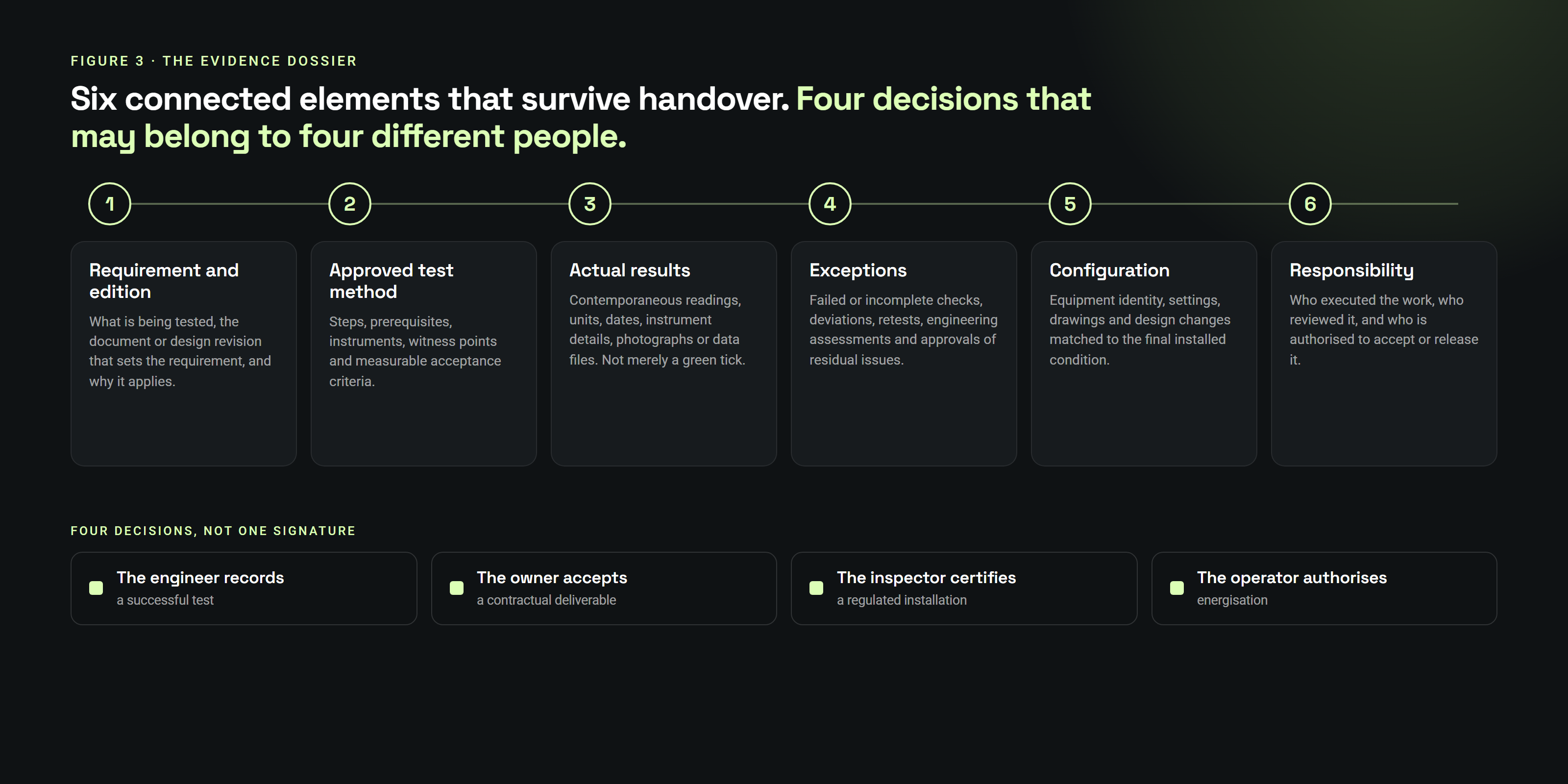 Six connected elements, and four decisions that may belong to four different people.
Independent witnessing is not always mandatory. In some systems it is specifically required by an inspection regime, certification scheme or approved validation process; in others, responsible review within the contractor or owner's team is appropriate. "Witnessed" is meaningful only when the witness has a defined responsibility.
Retention periods are not universal either. GMP has product- and record-specific rules; NERC standards prescribe particular evidence obligations for entities within their scope; permits, contracts and national law impose other requirements. Keeping the evidence available for the operating life of the asset is often a strong engineering default, but it is not a universally stated statutory retention rule. The project's record-retention schedule should reconcile all applicable obligations, including privacy and data-protection requirements.
Electronic records and signatures can be legally recognised, for example under the EU's eIDAS Regulation and the US ESIGN Act. But electronic recognition does not remove sector-specific requirements for identity assurance, access control, audit trails, record integrity or qualified signatures where required.
The distinction is crucial: the engineer may record a successful test, the owner may accept a contractual deliverable, the inspector may certify a regulated installation, and the system operator may authorise energisation. These can be four different decisions.
What this means on a job
Four habits are worth building into the project from day one.
Put the requirement on the test sheet. Include the actual applicable edition and revision, not whichever standard has the newest date on a publisher's website. Identify who decided it applies.
Approve the procedure before the test where required. Agree on the acceptance criteria and witness points. For critical systems, the worst time to discover a different interpretation of "Pass" is after the equipment has been energised.
Keep the original result. A number outside tolerance is not made compliant by rounding it, hiding it or replacing it with a passing retest. Record the original reading, investigate the discrepancy and make the disposition visible.
Leave an evidence trail that survives handover. The operations team needs the final configuration, the settings, the test history and unresolved limitations, not just an archive called Final_Commissioning_Pack_v7.
This is also the problem we are working on with Cx Assistant: keeping assets, project documents, test scripts, measured values, photos and issues connected, so the evidence can be found when somebody asks why a system was accepted. AI can help prepare test scripts, extract information and organise records. It must not be mistaken for the engineer, quality unit, inspector or operator authorised to make the final acceptance decision.
Compliance is not the word printed on the cover sheet. It is the traceable connection between the requirement, the installed system, the test result and the person authorised to accept it.
Interested in trying that workflow on a real project? Contact info@cx-assistant.com to discuss a pilot.
Primary sources and technical references
The links below are to regulators, standards publishers or issuing organisations. Where the full text of a standard is licensed, the link is to the issuer's official publication information rather than a third-party copy. This is a selected bibliography supporting the claims in this article, not a list of every code that may apply to an individual project.
Commissioning process, buildings and general electrical rules
- ASHRAE — Commissioning process publications (Guideline 0 and Standard 202).
- NFPA — NFPA 70 National Electrical Code; NFPA — NFPA 70B, current published 2026 edition.
- NETA — ANSI/NETA ATS-2025; IEC — IEC 60364-6:2016.
- California Energy Commission — 2025 Energy Code acceptance forms.
- EU — Directive 2024/1275 (EPBD recast).
- Spain — RD 842/2002 (low voltage); RD 337/2014 (HV installations); RD 223/2008 (HV lines).
- Mexico — NOM-001-SEDE-2012; Colombia — RETIE and its amendments; Brazil — NR-10, old and revised effective dates.
Data centers and energy
- Uptime Institute — awards and validity terms; TIA — ANSI/TIA-942-C announcement.
- EU — Energy Efficiency Directive 2023/1791, Article 12; Delegated Regulation 2024/1364.
- Germany — Energieeffizienzgesetz § 11; NEN — EN 50600-3-1:2026.
Pharmaceutical qualification
- European Commission — EudraLex Volume 4, Annex 15 (2015).
- PIC/S — PI 006-4 Recommendations on Qualification and Validation (1 October 2026).
- US — 21 CFR Part 211; FDA — process validation guidance (2011); FDA — Fareva Amboise warning letter (10 April 2026).
- European Commission — consultation on Chapter 4, Annex 11 and draft Annex 22.
- Brazil — ANVISA GMP regulations, including IN 138/2022; Mexico — NOM-059-SSA1-2015 amendment in 2025; Argentina — ANMAT Disposición 4159/2023.
Grid connections and transmission
- EU — Connection code 2016/631; Connection code 2016/1388.
- NERC — PRC-005-6; PRC-027-1; FAC-008-5.
- IEEE — IEEE 81-2025; FERC — Order No. 881 overview; PJM — March 2026 implementation; ISO New England — 2026 implementation schedule.
- Brazil — ONS new-facility integration; ANEEL — generating-facility operation in test and commercial service.
Records and signatures
See it in the product
The modules this post is about, each with its own page and guide.
Want to see Cx Assistant in action?
Explore how commissioning teams manage assets, issues, and documentation — in one place.
Start for free